
In the process of production, if we have a wrong understanding of the geometric tolerance marked on the drawings, the machining analysis and the machining results will deviate from the requirements, and even bring serious consequences.Today, let's take a systematic look at 14 geometric tolerances.
01 Straightness
Straightness, which is generally referred to as flatness, indicates that the actual shape of the linear element on the part remains an ideal straight line.Straightness tolerance is the maximum allowable variation between the actual line and the ideal line.
Example 1: in a given plane, the tolerance zone must be in the area between two parallel lines with a distance of 0.1mm.

Example 2: the tolerance value before charging Φ mark, the tolerance zone must be 0.08 mm in diameter in the area of the cylinder.

02 Flatness
Flatness, which is generally referred to as the degree of flatness, represents the actual shape of the plane element of the part and maintains the state of the ideal plane.The flatness tolerance is the maximum allowable variation of the actual surface to the ideal plane.
Example: a tolerance zone is an area located between two parallel planes 0.08mm apart.

03 Roundness
Roundness, also known as roundness, indicates that the actual shape of a circle element on a part is equidistant from its center.The roundness tolerance is the maximum allowable variation between the actual circle and the ideal circle on the same section.
Example: the tolerance zone must be on the same normal section and the radius difference is the area between two concentric circles with a tolerance value of 0.03mm.

04 Cylindricity
The degree of cylindricity is to show the points on the outline of the cylindrical surface on the part, and to keep equal distance to its axis.The cylindricity tolerance is the maximum allowable variation between the actual cylinder and the ideal cylinder.
Example: a tolerance zone is the area between two coaxial cylinders with a radius difference of 0.1mm.

05 Line contour
The line contour is the curve of any shape on the given plane of the part, which keeps its ideal shape.Line contour tolerance refers to the allowable variation of the actual contour of a non-circular curve.
Example: a tolerance zone is the area between two envelope lines of a series of circles with a tolerance diameter of 0.04mm.The centers of circles lie on lines that have a theoretically correct geometry.

06 Surface profile
The profile of a surface is a surface that represents any shape on the part and maintains its ideal shape.Surface contour tolerance refers to the actual contour of a non-circular surface and the allowable variation of the ideal contour.
Example: the tolerance zone consists of an envelope between two envelopes of a series of balls with a diameter of 0.02mm, the center of which is theoretically located on the face of the correct theoretical geometry.

07 Parallelism
The degree of parallelism, or the degree to which the actual element under test is kept equidistant from the reference on the part.The parallelism tolerance is the maximum allowable variation between the actual direction of the element under test and the ideal direction parallel to the datum.
Example: if the tolerance value before filling mark Φ as a benchmark, the tolerance zone inside the cylinder of parallel Φ 0.03 mm in diameter.

08 Verticality
Perpendicularity, which is generally referred to as the degree to which the two elements remain orthogonal, indicates that the measured element on the part maintains the correct 90° Angle relative to the reference element.The perpendicularity tolerance is the maximum allowable variation between the actual direction of the element under test and the ideal direction perpendicular to the reference phase.
Example 1: filling mark Φ before tolerance zone, the tolerance zone is perpendicular to the datum within the cylinder diameter is 0.1 mm.

Example 2: the tolerance zone must be located between two parallel planes with a distance of 0.08mm and perpendicular to the datum line.

09 Gradient
The degree of inclination is the correct condition that the relative direction of two elements on the part keeps any given Angle.The inclination tolerance is the maximum allowable variation between the actual direction of the element under test and the ideal direction based on any given Angle.
Example 1: the tolerance zone of the axis under test is the area between two parallel planes with A distance of 0.08mm and A theoretical Angle of 60° from the datum plane A.

Example 2: filling mark Φ before tolerance value, the tolerance zone must be located within the cylinder diameter is 0.1 mm.The tolerance zone shall be parallel to plane B perpendicular to datum A and at A theoretically correct Angle of 60° from datum A.

10 Position degrees
Position degree is to represent the point, line, surface and other elements on the part, relative to its ideal position of the accurate situation.Position tolerance is the maximum allowable variation of the actual position of the measured element relative to the ideal position.
Example: before the tolerance zone filling mark S Φ, tolerance zone is 0.3 mm diameter ball inside the area.The position of the center point of the spherical tolerance zone is the theoretical correct size relative to datum A, B and C.

11 Coaxial (concentric) degree
Coaxiality, which is commonly referred to as the degree of coaxial, means that the measured axis on the part is kept on the same line with respect to the reference axis.The coaxiality tolerance is the allowable variation of the actual axis under test with respect to the reference axis.
Example: when marking tolerance values, the tolerance zone is the area between cylinders 0.08mm in diameter.The axis of the circular tolerance zone is in line with the datum.

12 Degree of symmetry
Degree of symmetry refers to the state in which two symmetrical central elements of a part remain in the same central plane.The tolerance of symmetry degree is the allowable variation of the center plane (or center line or axis) of the actual element to the ideal symmetry plane.
Example: a tolerance zone is an area between two parallel planes or lines with a distance of 0.08mm and a symmetrical configuration relative to the reference center plane or center line.

13 Circular run-out
Circular run-out refers to the condition that the rotary surface on the part remains in a fixed position relative to the datum axis within a defined measuring surface.The circular runout tolerance is the maximum allowable variation within a limited measurement range when the actual element under test rotates a full circle around the reference axis without axial movement.
Example 1: a tolerance zone is an area perpendicular to any measurement plane, with a radius difference of 0.1mm and a center of the circle between two concentric circles on the same datum axis.
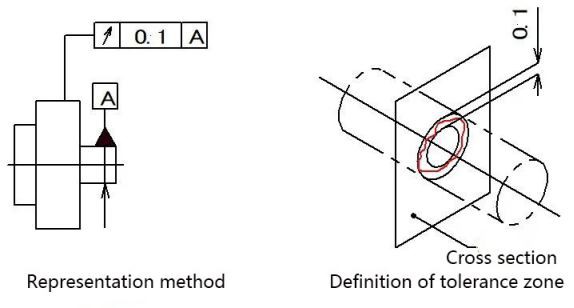
Example 2: a tolerance zone is the area between two circles on the measuring cylinder at a distance of 0.1mm at any radius along the base line.

14 Full run-out
Full run-out refers to the run-out along the whole measured surface when the part rotates continuously around the datum axis.The full runout tolerance is the maximum runout allowed when the actual element under test rotates continuously around the datum axis while the indicator moves relative to its ideal contour.
Example 1: a tolerance zone is an area between two cylinders with a radius difference of 0.1mm and coaxial to the reference.
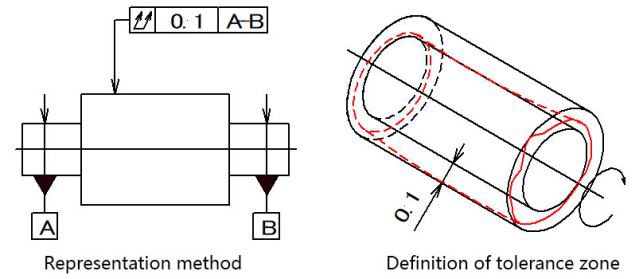
Example 2: a tolerance zone is an area between two parallel planes with a radius difference of 0.1mm and perpendicular to the reference.
