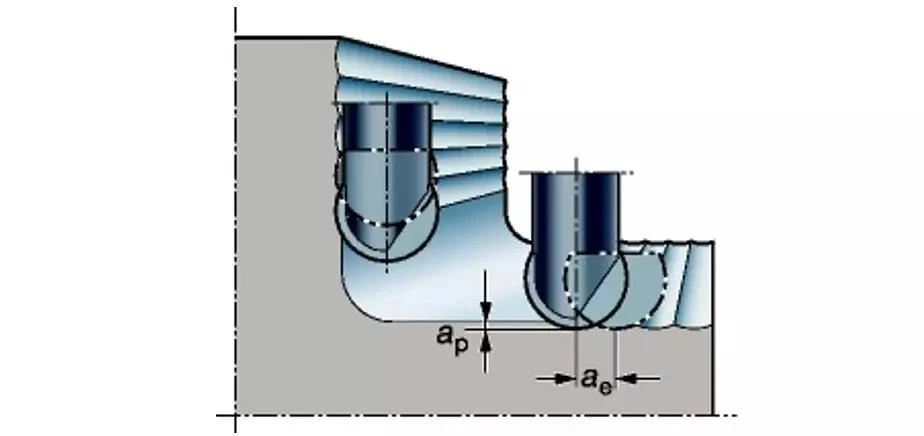
What does milling surface formation depend on?The resulting milling surface may be axial, radial, or complex depending on the type of tool used and the type of process used.
01
Axially generated surface
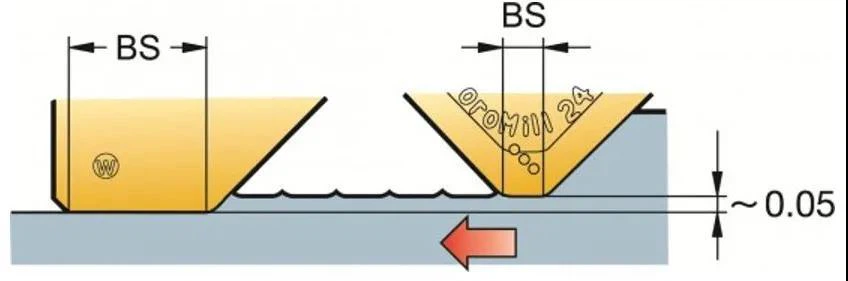
The bottom shape of the blade determines the resulting surface quality.The arc of the tool tip (RE) sometimes produces a cusp.The size of the spire depends on the radius of the arc and the feed.
A blade with a parallel edge band (BS) can be machined to a plane.Depending on the axial tolerance and runout of the milling cutter, the most protruding blade generates the final surface.

Circular radius of tool tip (RE) and parallel edge band (BS)
In order to process the best milling surface quality, it is important to ensure that the feed per revolution (fn = fz×zn) is less than 80% of BS.
As the milling cutter diameter increases (and for super-dense tooth milling cutters), the number of teeth and the amount of feed per revolution increases, resulting in the need for larger BS.Once the feed per rotation exceeds the width of the parallel blade, the axial runout of the milling cutter will affect the surface quality.
To obtain the best milling surface quality:
1) use Wiper (trimming edge) blades with BS at least 25% larger than fn or other milling blades with trimming edge
2) better finish can be obtained by using cermet blade
3) use cutting fluid to avoid bonding
Wiper blade
Finishing edge or long parallel edge belt can realize finishing with larger diameter.The trimming edge is higher than the standard blade to ensure that the trimming edge produces the final surface.Maximum fn should not exceed 80% of BS.
Circular blade
Circular blades or blades with a large circular radius of the tip can achieve high productivity, but not high quality surfaces.The larger the diameter of the milling cutter, the worse the surface quality.
02
Radially generated surface
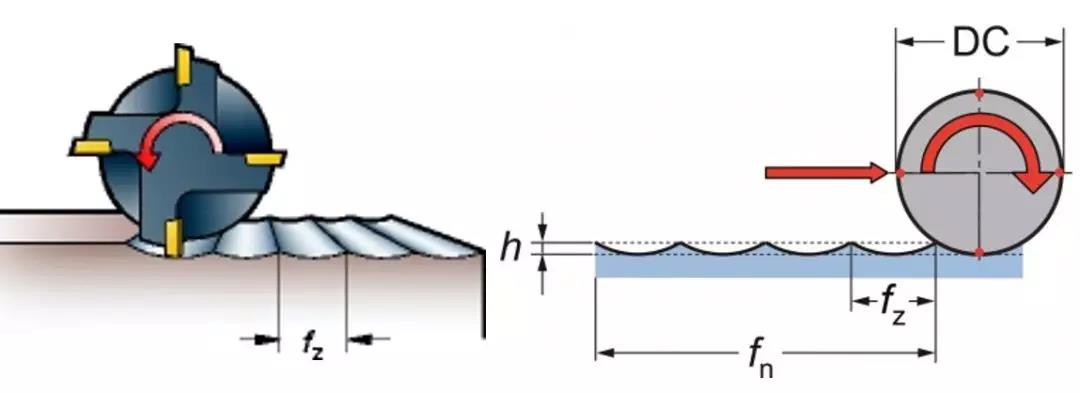
Radial surfaces are generated when using end mills, square shoulder mills, or three-sided edge mills.For radially generated surfaces, the profile is processed by the tool side edge.
Each tooth is machined into a spire (h), where the width of the spire is equal to fz per tooth feed, and the depth of the spire is determined by the relationship between the milling cutter diameter and fz.The theoretical calculation results in the smallest tip size.
03
Complex surface formation
Complex surfaces are generated when ball end milling cutters are used.