
First, let's introduce what a bevel gear is. Bevel gears are used to transmit motion and power between two intersecting shafts. In general machinery, the angle between the two shafts of the bevel gear is equal to 90° (but it may not be equal to 90°). Similar to cylindrical gears, bevel gears have indexing cones, tip cones, root cones and base cones. The cone has a big end and a small end, and the circles corresponding to the big end are called the index circle (radius R), the addendum circle, the root circle and the base circle, respectively. The motion of a pair of bevel gears is equivalent to the pure rolling of a pair of pitch cones.
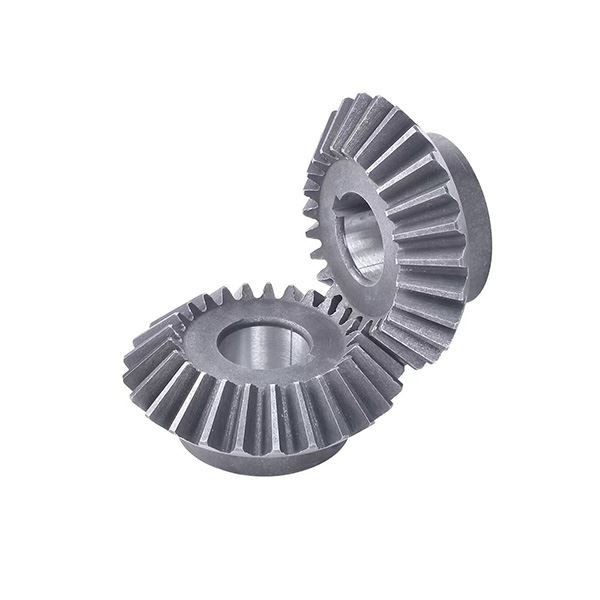
Then, the difference between bevel gears and helical gears is in the following aspects
1. Different applications
(1) Bevel gear: a gear that transmits the driving force of fitness exercise between two horizontal shafts
(2) Helical gear: reduction transmission system
2. The difference is the characteristic
(1) Bevel gear characteristics: the angle between the two shafts of the bevel gear is equivalent to 90°;
(2) Helical gear features: small size, light weight, large transmission torque, stable starting, fine classification of reduction ratios, and optional connections and various installation parts according to customer requirements.
Helical gears are not exactly helical gears. It should be said that a helical gear is the meshing method of two helical gears, and the difference lies in the direction in which they transmit force in space. Ordinary spur gears mesh along the tooth width direction at the same time, resulting in shock vibration noise and unstable transmission. The helical gear transmission is superior to the spur gear transmission, which can make the center distance close to the center distance at high speed and heavy load.
Bevel gears, also known as bevel gears, are widely used in industrial transmission equipment, vehicle differentials, locomotives, ships, power plants, steel plants, railway track testing, etc. The main parameters of bevel gears: number of teeth, modulus, pressure angle, tooth tip height , tooth root height, face cone angle (top cone angle), secondary cone angle (pitch cone angle), root cone angle, back cone distance, wheel crown distance, installation distance, setting tooth thickness, setting tooth height, displacement coefficient, Backlash etc.